On May 15, 2026, Trump concluded his three-day visit to China. From the guard-of-honor welcome at the Great Hall of the People to a leisurely stroll through the Temple of Heaven with President Xi, from Trump’s declaration that “a lot of problems were settled” to Xi’s stark warning that Taiwan could become “dangerous” — the summit, billed by the White House as “the most important great power meeting of the 21st century,” revealed both genuine goodwill in stabilizing US-China ties and the irreducible reality of deep structural contradictions.
I. Three Days: Maximum Ceremony, Minimum Deliverables
Across three days, Beijing spared no effort in the optics. Red carpets, honor guards, and full diplomatic pageantry greeted Air Force One. On May 14, Xi and Trump walked side by side through the Temple of Heaven park, planting a “friendship tree” together — an image of “dragon and eagle dancing” that went viral globally. That evening, a state dinner at the Great Hall of the People featured a fusion menu of roast duck, beef ribs, and ice cream, which became social media fodder far beyond diplomatic circles.
But ceremony is not substance. CNN’s post-summit analysis was blunt: “Trump brought top CEOs to Beijing but few big deals emerged.” Reuters was more precise: “Xi and Trump declare summit a success but differences remain — on Iran and Taiwan.” US Treasury Secretary Bessent had publicly expected a major Boeing order. As of Trump’s departure from Beijing, no binding agreement had been finalized.
This was not accidental. Trump’s real objective was performance over negotiation — projecting a strongman image to domestic voters, showcasing personal chemistry with Xi, and signaling to the world that US-China relations could be “stabilized” even as US-Russian ties cooled and US-European friction intensified.
II. Taiwan: The Live Wire That Never Goes Quiet
If trade was the “face” of this visit, Taiwan was the “spine.”
Xi told Trump directly, according to CBS News: mishandling Taiwan could lead to a “dangerous” situation. The Taiwan question, which China defines as the “most important issue” in US-China relations, is not diplomatic rhetoric — it is a bright line. Trump’s response, at the post-summit press conference, was characteristically evasive: Xi is “a very good man” who “will do the right thing on Taiwan.” No substantive policy guarantee. No concrete commitment.
That strategic ambiguity is both Trump’s style and America’s genuine dilemma: Washington wants to use the Taiwan card to constrain China, but is unwilling to pay the full price of direct confrontation. The subtext of this summit was clear: China and the United States can coexist under a framework of “strategic stability,” but Taiwan is a tripwire that could shatter that framework at any moment.
III. The Iran博弈: Beijing’s Asymmetric Leverage
One critically underreported dimension of this visit was Iran.
Following the outbreak of the US-Israel war on Iran in early May 2026, with the Strait of Hormuz in crisis, Trump came to Beijing with an explicit ask: use China’s leverage over Tehran to reduce Iranian resistance or signal willingness to scale back. The result? Al Jazeera’s deep analysis put it plainly: “Xi-Trump summit failed to yield Iran war breakthrough — US officials nudged China to do more on the blocked Hormuz strait. President Xi doesn’t appear to have budged.”
During the summit, a quietly significant development emerged: Chinese vessels were granted passage through the Strait of Hormuz. In the midst of a US-Israel blockade of Iranian shipping lanes, China effectively secured a strategic corridor — not as a US concession, but as something Beijing negotiated on its own terms.
This reveals a core logic of China-US competition in the Middle East: China will not sacrifice its strategic position in Iran to accommodate American objectives. Iran is a critical node in China’s Belt and Road footprint and a key dimension of its Middle Eastern presence. Trump overestimated what one summit — and personal charm — could accomplish against the weight of geopolitical interest.
IV. The Thucydides Trap and the Shadow of Power Transition
During the summit, Xi raised a historical concept directly with Trump: the Thucydides Trap — the historical pattern in which a rising power’s challenge to an established hegemon leads to war. This was remarkable. China — the rising power — was itself invoking the framework, signaling to Washington: we know the historical parallel, and we’re aware of the risk.
ABC News reported Trump’s response: he acknowledged it was “a very good question” but denied American decline, insisting “we are stronger than ever.” That reflexive confidence is itself revealing. By 2026, the US-China power balance has evolved from “America leads, China catches up” to “near-peer competitors with distinct advantages.” America retains military and financial system dominance, but China has built irreplaceable leverage in manufacturing, supply chains, and geopolitical positioning. This summit itself is a product of that shifted balance — Trump had to come to Beijing, and Xi chose to receive him.
Is the Thucydides Trap inevitable? No. But this summit showed that both sides are, at minimum, exploring a path of “managed competition” rather than headlong confrontation. That is a positive signal, but only a limited one.
V. A Renamed Secretary of State and Family Business Diplomacy
One detail from this visit crystallizes the trust deficit at the heart of US-China relations.
US Secretary of State Marco Rubio, who is under Chinese sanctions, could not attend the summit in his official capacity. Beijing’s solution: rename him “Marco Lu” and admit him under that alias. The episode — “diplomacy by pseudonym” — superficially a bureaucratic workaround, actually reflects the deep structural friction between two systems that do not trust each other enough for normal diplomatic procedures.
Meanwhile, Eric Trump’s presence in the delegation sparked criticism. A family member joining what should be a strictly professional diplomatic mission raised questions about nepotism and conflicts of interest, and the symbolism was not lost on either side.
These details may seem trivial in the grand narrative of great power rivalry, but collectively they underscore a vital truth: improving US-China relations requires more than top-level strategic frameworks. It requires institutional trust and mutual respect across multiple levels — neither of which can be manufactured by a state dinner or a walk in the Temple of Heaven.
Conclusion: Stability Is Not Resolution
After three days in Beijing, Trump got what he came for: the “face” of strongman diplomacy, a personal relationship with Xi, visible “stability” in US-China ties, and a summit to project to domestic audiences. But the summit changed nothing structural:
- Taiwan: The tripwire remains live and armed
- Iran: China’s interests are fundamentally opposed to America’s regional strategy
- Trade and technology: The broad framework of tariffs, export controls, and tech decoupling stayed intact
- Geopolitical rivalry: In the East China Sea, South China Sea, and Middle East, China will not move simply because Trump and Xi shared a nice dinner
The most honest verdict: the biggest achievement of this summit was preventing further deterioration. In a US-China relationship shaped by intense competition and hostile domestic politics on both sides, “not getting worse” is itself meaningful.
But stability is not an endpoint. The real question for the world’s two largest economies is: how do you build rules for competition, find cooperation in rivalry, and prevent manageable disagreements from becoming catastrophic conflicts?
That question will not be answered by one stroll through the Temple of Heaven or one state dinner with roast duck. It will be answered — or not — in the difficult, grinding negotiations across dozens of specific issues that follow.
The next Trump-Xi meeting will be the real test of what, if anything, this summit actually left behind.
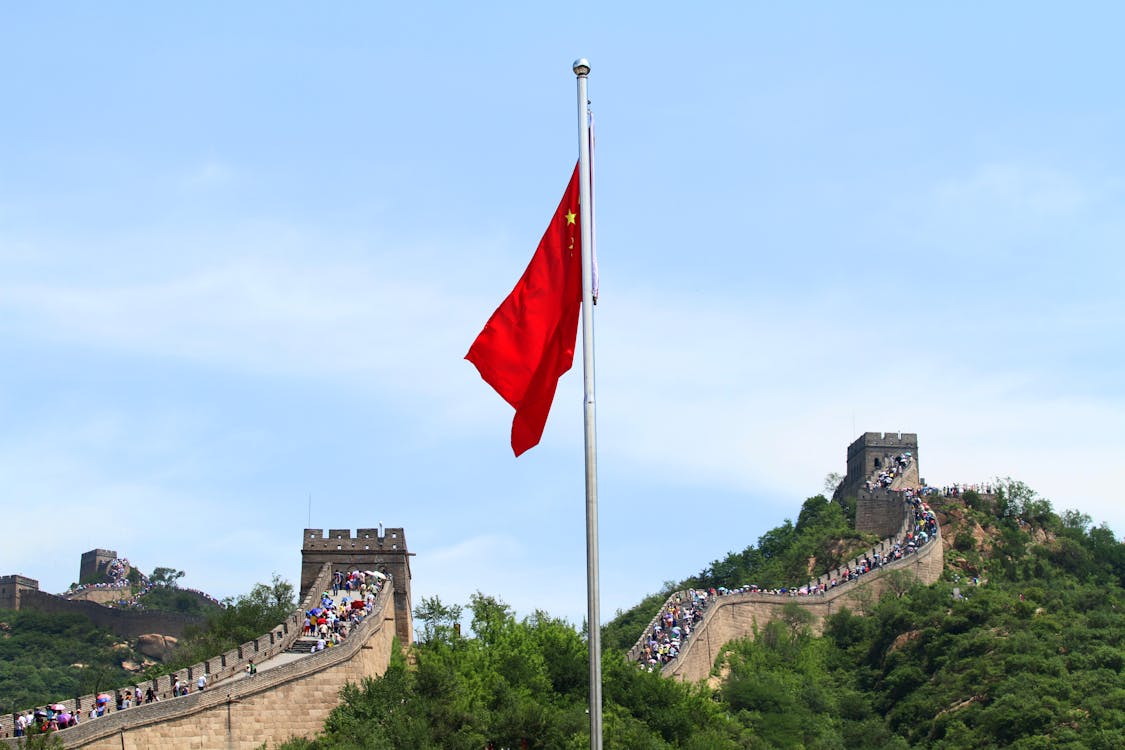
Cover image: Great Wall of China with Chinese national flag, photo by Ramaz Bluashvili, via Pexels.
Leave a comment