Introduction
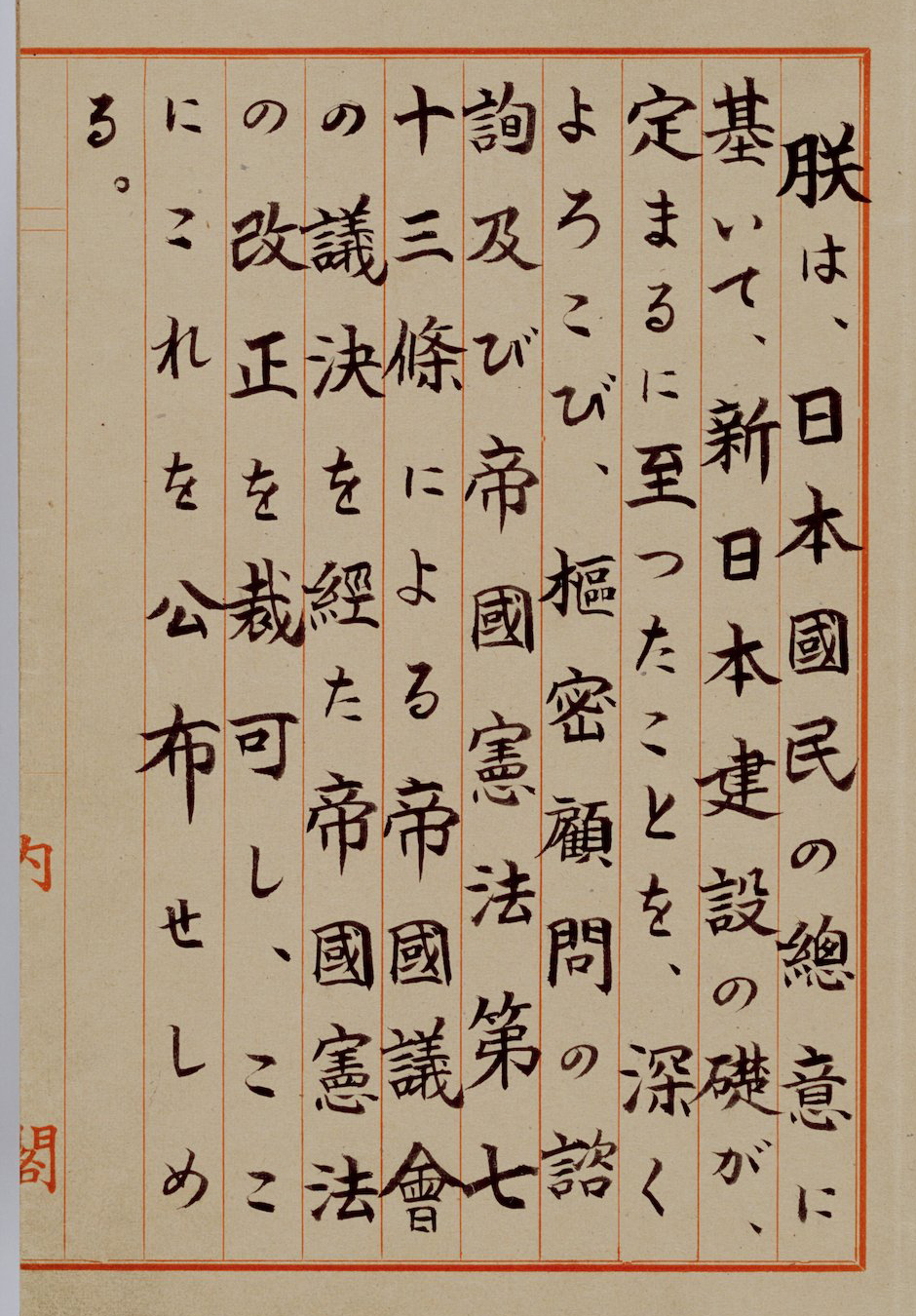
In the aftermath of World War II, Japan adopted the Peace Constitution under American occupation, whose Article 9 formally renounced war and the maintenance of military forces. Yet this provision was contentious from its inception. More than seven decades later, the debate over constitutional reform is not merely about Japan’s defense posture — it reflects a deeper reckoning with how Japanese society confronts its own wartime history. Drawing on extensive American and European scholarship, this article maps the contours of this complex and consequential issue.
1. The Historical Birth of Article 9
- A Product of American Occupation: Historian John Dower meticulously narrates the political context of Article 9’s creation in Embracing Defeat — it was simultaneously a tool by the MacArthur administration to remold Japanese society and a symbolic bedrock for Japan’s postwar peace movement (Dower 1999, pp. 318-340).
- Acceptance and Resistance in Japan: European scholar Hans Kristensen notes that the Peace Constitution was widely perceived by many Japanese as “imposed from outside,” even as it became integral to Japan’s national identity discourse (Kristensen 2005).
- Cold War Transformations: The United States, motivated by Cold War priorities, gradually facilitated Japan’s rearmament, progressively hollowing out the constraints of Article 9 throughout the Cold War era (Buzan & Wæver 2003).
2. The Realpolitik of the Constitutional Reform Movement
- Domestic Political Dynamics: American scholar Michael Auslin analyzes in The Japan Telescope how conservative factions within the LDP have framed constitutional reform as an essential step toward restoring “normal nation” status, while public opinion remains deeply divided (Auslin 2017).
- American Strategic Calculations: Washington has not opposed Japanese constitutional reform outright but has maintained a position of “conditional support” — eager for Japan to assume greater defense responsibilities while wary of triggering an arms race in East Asia. Peter Drysdale observes in The Japan Times that this represents the most delicate tension within the US-Japan alliance (Drysdale 2019).
- Regional Vigilance: China and South Korea monitor Japanese constitutional reform closely. Sheila Smith documents the impact of Japan’s military normalization on regional security dynamics in Japan Rearmed (Smith 2020).
3. Historical Revisionism: The Logic and Motivations of Denial
- Limits of Postwar Accountability: European scholar Ian Buruma offers a penetrating comparative analysis in The Wages of Guilt — while Germany underwent the Nuremberg trials and extensive public reckoning, America’s主导的 postwar settlement in Japan was deliberately abbreviated. Emperor Hirohito’s immunity from prosecution foreclosed the possibility of deep social reckoning (Buruma 1994).
- Textbooks and the Yasukuni Question: American historian Herbert Bivens’s research on Japanese history textbooks demonstrates that every Japanese government attempt to modify textbook language since the 1980s has provoked fierce backlash from China and South Korea — not accidentally, but as a predictable response to a systematic effort to sanitize wartime atrocities (Bivens 2015).
- The Role of Political Elites: John Breen’s work on the Yasukuni problem reveals that political elite visits to the shrine represent a carefully calibrated act — walking a tightrope between domestic nationalist supporters and international peace-oriented pressure — with each step governed by precise political calculation (Breen 2018).
4. The International Dimension of Historical Denial
- History as a Factor in US-Japan Relations: Although the United States maintained “strategic silence” on Japanese historical revisionism during the Cold War, that silence eroded significantly after the 1990s. Herbert Calhoun argues that when Japan began “de-criminalizing” its wartime conduct, it directly threatened the moral foundations of America’s East Asian value-based alliance (Calhoun 2011).
- The European Comparative Lens: Robert Haas of the Council on Foreign Relations observes that Japan’s handling of history generates more controversy than Germany’s precisely because Japan lacks a landmark moment of contrition analogous to Chancellor Willy Brandt’s Kniefall von Warschau (Warsaw Genuflection), combined with a persistent pattern of elite manipulation of social memory (Haas 2018).
Conclusion
The constitutional reform debate and historical revisionism are not separate issues — they share a common underlying logic: how Japan is repositioning its historical identity in the 21st century. Conservatives seek to dismantle postwar “peaceist constraints” through constitutional reform; denying or minimizing wartime crimes provides the historical legitimacy for this political transformation. To understand the trajectory of contemporary Japanese politics, one must situate it within the accumulated layers of historical grievance and geopolitical calculation spanning seven decades since 1945.
References
- Auslin, Michael. The Japan Telescope: Observing the Future of the Pacific. Yale University Press, 2017.
- Breen, John, ed. The Fuji in the Sky: The Yasukuni Problem. Routledge, 2018.
- Bivens, Herbert. “Remembering Pearl Harbor, Forgetting the Rape of Nanking.” Oxford Historical Review, 2015.
- Buruma, Ian. The Wages of Guilt: Memories of War in Germany and Japan. Farrar, Straus and Giroux, 1994.
- Buzan, Barry & Wæver, Ole. Regions and Powers: The Structure of International Security. Cambridge University Press, 2003.
- Calhoun, Herbert. Japan’s Post-War Security Policy. RAND Corporation, 2011.
- Drysdale, Peter. “Japan’s Constitutional Puzzle.” Japan Times, 2019.
- Dower, John. Embracing Defeat: Japan in the Wake of World War II. W.W. Norton, 1999.
- Haas, Robert. “The Comfort Women and the Legacy of Imperial Japan.” Council on Foreign Relations, 2018.
- Kristensen, Hans. The Japanese Constitution After Fifty Years. Columbia University Press, 2005.
- Smith, Sheila. Japan Rearmed: The Rise of Japanese Militant Nationalism. Oxford University Press, 2020.
Leave a comment