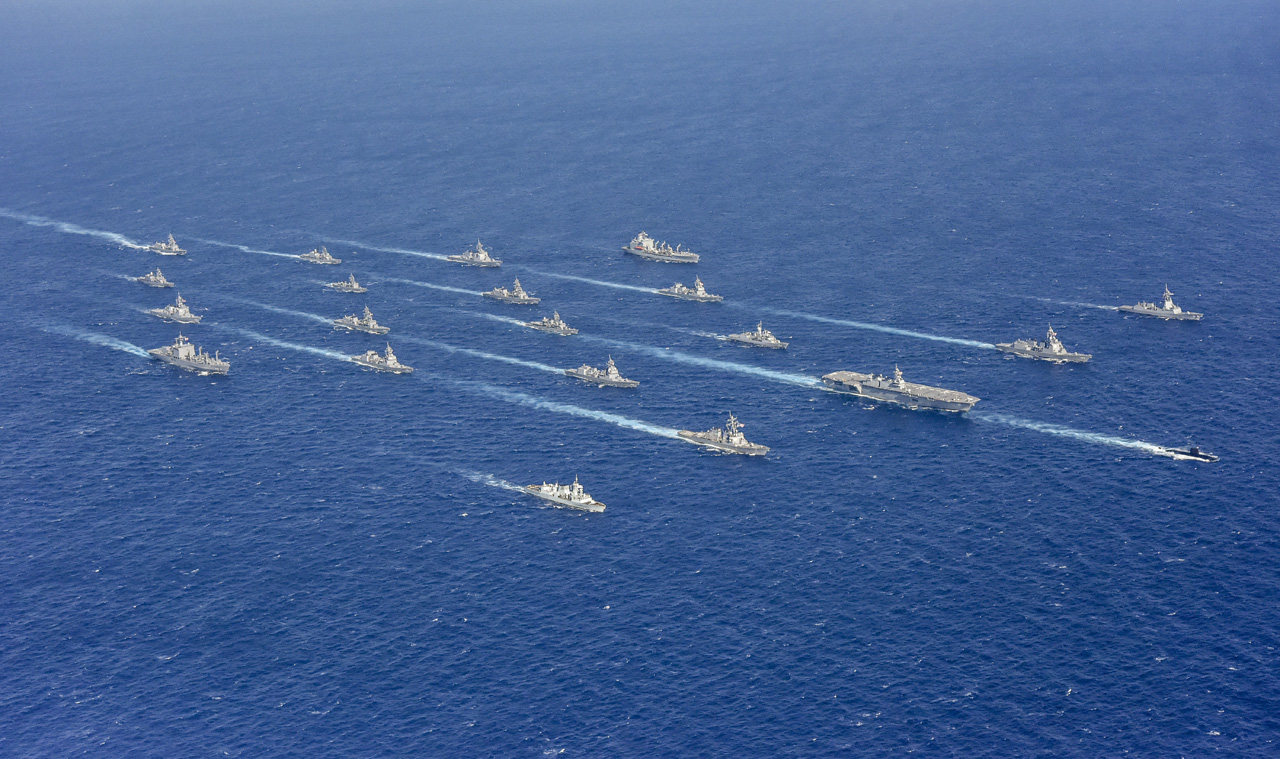
Military Rearmament and Geopolitics: Escalating Regional Tensions
In 2015, Japan’s security legislation marked the end of the postwar era of the “exclusively defensive defense” policy. In 2022, Japan announced it would raise defense spending to 2% of GDP within five years, formally entering the global arms race.
From a “peace nation” to a “normal state,” Japan’s strategic transformation is reshaping East Asia’s security landscape.
This is the fourth article in the “Reflections on Japanese Militarism” series, examining contemporary Japan’s military expansion and its geopolitical consequences.
Part 1: Record-Breaking Defense Spending Growth
From 1% to 2%: A Watershed in Military Expansion
During the Cold War, Japan maintained defense spending below 1% of GDP — a self-imposed constraint that served as both a symbol of restraint and a policy anchor of postwar pacifism. In December 2022, the Japanese government approved a new National Security Strategy (NSS) at a cabinet meeting, announcing plans to raise defense spending to 2% of GDP by 2027, aligning with NATO standards.
The watershed significance of this shift should not be underestimated:
- FY2023 defense budget: Approximately ¥6.8 trillion (~$50 billion), a record high
- FY2024 defense budget: Further increased to approximately ¥7.9 trillion, a breakthrough 16% growth
- 2027 projection: Defense budget could exceed ¥10 trillion, ranking Japan among the world’s top five military spenders
According to SIPRI (Stockholm International Peace Research Institute) data, if Japan achieves the 2% target, its military spending would exceed Germany, India, and the United Kingdom, making it the third-largest military spender after the United States and China.
Procurement of Offensive Weapons: A Qualitative Transformation
Alongside the budget surge is a qualitative leap in weapons systems. Japan has in recent years procured a series of weapons with clearly offensive characteristics:
- F-35 stealth fighter: Over 40 have been procured, with plans to test short take-off and vertical landing (STOVL) operations on Izumo-class helicopter destroyers, giving them light aircraft carrier capability
- Tomahawk cruise missiles: In 2023, the U.S. State Department approved the sale of up to 400 Tomahawk Block 5 cruise missiles to Japan — Japan’s first acquisition of offensive cruise missiles in the postwar era
- Enhanced Type 12 anti-ship missile: Extending the original Type 12’s range from 200 km to 1,500 km, sufficient to cover China’s eastern coastal regions
- Aegis destroyers and expanded large surface combat fleet: Japan’s Maritime Self-Defense Force is strengthening its blue-water operational capabilities
These procurement plans have far exceeded the “exclusively defensive defense” requirements for homeland protection, expanding the SDF’s strategic capabilities from territorial defense to preemptive “strike capabilities.”
Part 2: Transformation of the U.S.-Japan Alliance: From Umbrella to Combined Operations
Trajectory of Alliance Evolution
The Treaty of Mutual Cooperation and Security between the United States and Japan, signed in 1951, entrusted Japan’s security to America’s nuclear umbrella. During the Cold War, the core logic of the U.S.-Japan alliance was: the United States provided the “nuclear shield” while Japan provided the “forward base” — an arrangement known as “Umbrella Deterrence.”
However, as China’s rise and the North Korean nuclear threat intensify, the U.S.-Japan alliance is undergoing structural transformation:
- 1996 U.S.-Japan Joint Declaration on Security: Expanded the alliance’s scope from “the area surrounding Japan” to the “Asia-Pacific region”
- 2015 New Security Legislation: Permitted the SDF to provide logistical support to U.S. forces during “situations of existential threat” and to “non-combatively” participate in U.S. military operations during “armed attack situations”
- 2023 Camp David Agreements: The trilateral U.S.-Japan-ROK summit reached three pillars of cooperation — intelligence sharing, supply chain resilience, and regional deterrence — extending the alliance toward trilateralization
Building Combined Command and Control Capabilities
In recent years, the United States and Japan have been accelerating the construction of wartime combined command and control systems, including shared intelligence systems, integrated combat platforms, and joint training mechanisms. In 2024, the United States and Japan held their largest-ever joint exercise, “Keen Edge,” simulating responses to contingencies involving the “Southwest Islands” (i.e., the Senkaku/Diaoyu Islands and adjacent areas).
Part 3: Territorial Disputes — Structural Obstacles in China-Japan and Japan-Korea Relations
Senkaku/Diaoyu Islands: Escalating Sovereignty Contest
The Senkaku Islands (called Diaoyu by China) represent the most volatile territorial dispute between China and Japan. After Japan’s government “nationalized” the islands in 2012, Chinese government vessels frequently entered Senkaku territorial waters, sending China-Japan relations to a freezing point.
In recent years, the militarization risk of the Senkaku dispute has been continuously escalating:
- Normalization of Chinese coast guard patrols: Chinese coast guard ships and naval vessels frequently enter the Senkaku contiguous zone; Japan’s Air Self-Defense Force emergency scrambles against Chinese aircraft continue to increase
- Reinforced Japanese military deployment in the southwest: Japan has deployed electronic warfare units and anti-ship missile positions in the Okinawa Islands, designating the southwest direction as the “highest priority defense direction”
- Deep U.S. intervention: The United States has explicitly stated that the Senkaku Islands are covered by Article 5 of the U.S.-Japan Security Treaty; if armed conflict erupts over the Senkakus, U.S. forces would be obligated to intervene
Dokdo/Takeshima: Trigger for Japan-Korea Confrontation
Dokdo (called Takeshima by Japan), controlled by South Korea, represents a structural obstacle in Japan-South Korea relations. In 2023, the Yoon Suk-yeol government unveiled its “Three-Axis System” defense strategy, incorporating Japan into the “liberal peace共同体” partnership, marking a breakthrough in Japan-South Korea security cooperation. However, the sovereignty issue over Dokdo remains a sword of Damocles — any surge in nationalist sentiment on either side could vaporize security cooperation achievements.
Part 4: Neighboring Countries’ Concerns — Dual Anxiety of History and Reality
China’s Vigilance
China’s concerns about Japan’s military trajectory carry both historical and contemporary dimensions:
- Historical dimension: The memory of the war of aggression and the Nanking Massacre keeps China highly alert to any Japanese military expansion
- Contemporary dimension: Japan has designated China as “the greatest strategic challenge to date” and has significantly increased its threat narrative regarding China in its Defense White Papers
Chinese military experts generally believe that Japan’s military expansion is driven by U.S. “Indo-Pacific Strategy,” aiming to construct an “Asian NATO” targeted at China. In 2023, Chinese military aircraft repeatedly approached the Senkaku Islands and the midline of the East China Sea; PLA Navy and Air Force activities continued extending deep into the Pacific.
South Korea’s Ambivalent Mindset
South Korea also harbors ambivalent feelings about Japan’s remilitarization: on one hand, the Yoon government hopes to strengthen trilateral U.S.-Japan-South Korea security cooperation to address the North Korean nuclear threat; on the other hand, unresolved historical issues (especially the comfort women agreement and forced labor compensation) keep South Korean public trust in Japan low.
In 2023, despite breakthroughs in Japan-South Korea security cooperation, the lack of substantive progress on historical issues left the emotional divide between both publics deep and wide.
Part 5: Reconfiguration of Regional Security Architecture — The Era of Multipolar Competition
The Acceleration of Military Modernization Across the Region
Japan’s military expansion is not an isolated phenomenon but part of a broader escalation of military competition across East Asia:
- China: 2023 defense budget approximately $224 billion (official figure), actual spending likely much higher; comprehensive acceleration of military modernization
- South Korea: 2023 defense budget approximately $44 billion, with plans for 40% growth over the next five years
- North Korea: Continuous nuclear tests and missile launches; Kim Jong-un has written nuclear weapons into the constitution
- Taiwan: Procuring F-16V fighter jets, Harpoon anti-ship missiles, and other U.S.-made weapons; strengthening asymmetric warfare capabilities
In this “security dilemma” cycle, each country’s military expansion becomes the pretext for another’s — a vicious spiral of escalation.
Conclusion
Japan’s military remilitarization is the product of multiple converging factors: structural pressure from China’s rise, the realistic challenge of the North Korean nuclear threat, the geopolitical design of the U.S. “Indo-Pacific Strategy,” and Japan’s domestic political agenda of “national normalization.”
However, history teaches us that military expansion is never a unidirectional cause-and-effect chain but a systemic interaction. Japan’s military buildup inevitably triggers China’s counter-measures; China’s counter-measures, in turn, become Japan’s justification for further expansion. In this spiral, each side claims to be the “victim” and “defender,” yet together they push regional dynamics toward dangerous directions.
The only path to breaking this cycle is establishing a genuinely inclusive regional security dialogue mechanism — replacing bloc confrontation with multilateralism, and arms racing with dialogue and negotiation. Otherwise, East Asia will inevitably slide toward larger-scale military conflict.
Series Preview: The final article in this series will analyze, from a cultural perspective, how Japanese militarism continues in contemporary Japanese popular culture, education, and public discourse in both covert and overt ways.
References
- SIPRI Yearbook 2023, Stockholm International Peace Research Institute.
- Council on Foreign Relations (CFR), “The U.S.-Japan Alliance,” CFR Backgrounder, 2023.
- Ministry of Defense, Japan, Defense of Japan 2023 (Annual White Paper).
- International Institute for Strategic Studies (IISS), The Military Balance 2024, Routledge.
- “China’s Defense White Paper 2023,” State Council Information Office, People’s Republic of China.
Leave a comment