The Iron Hooves of Expansion: Japanese Aggression and Crimes Before WWII
On the night of September 18, 1931, an explosion near Liutiaohu in the northern suburbs of Shenyang shattered the brief peace of East Asia and inaugurated the darkest chapter of Japanese militarist expansion. From Manchuria to North China, from East China to Southeast Asia, the iron hooves of Japanese imperialism trampled across half of Asia over fifteen years, leaving wounds that remain unhealed to this day.
This is the second article in the “Reflections on Japanese Militarism” series. Here we systematically examine the historical trajectory of Japanese aggressive expansion during this period and analyze the major war crimes and their underlying ideological roots.
Part 1: 1931: The Mukden Incident and the Establishment of Manchukuo
The Mukden Incident: A Calculated Aggression
On September 18, 1931, the Japanese Kwantung Army secretly detonated a section of the South Manchuria Railway near Liutiaohu in Shenyang’s northern suburbs, framing Chinese Northeast Army troops, and immediately used this as a pretext to launch a military offensive. Within a few months, all three provinces of Northeast China fell under occupation, and Japan established its colonial governing body — the Kwantung Army Command.
This was no so-called “sporadic conflict” but the product of long-term planning by the Japanese military. The 1930 edition of the Imperial Defense Policy had already identified China as the primary hypothetical enemy, and the Army General Staff had drawn up detailed schedules for the invasion of China. After the Mukden Incident, domestic Japanese public opinion, manipulated by the military, quickly shifted to support the war against China. “National security” became the smokescreen for expansion.
The Puppet Rule of Manchukuo
In 1932, Japan installed the deposed Qing Emperor Puyi to establish “Manchukuo,” a puppet state that was in reality controlled by the Japanese Kwantung Army. The abundant coal, steel, and grain resources of Northeast China were massively plundered to sustain Japan’s war machine. Hundreds of thousands of Chinese farmers were forced from their land, and tens of millions lived under harsh colonial rule.
The establishment of Manchukuo marked Japan’s formal incorporation of Northeast China into its colonial system, laying both material and strategic foundations for the subsequent full-scale war against China.
Part 2: 1937: The Full-Scale War of Aggression Against China and Three Major Atrocities
The Marco Polo Bridge Incident: Eruption of Total War
On July 7, 1937, the Marco Polo Bridge Incident erupted. Japan, using the excuse that one soldier was “missing,” demanded to search Wanping City. After being refused, Japanese forces attacked. The Chinese nation faced its most perilous moment.
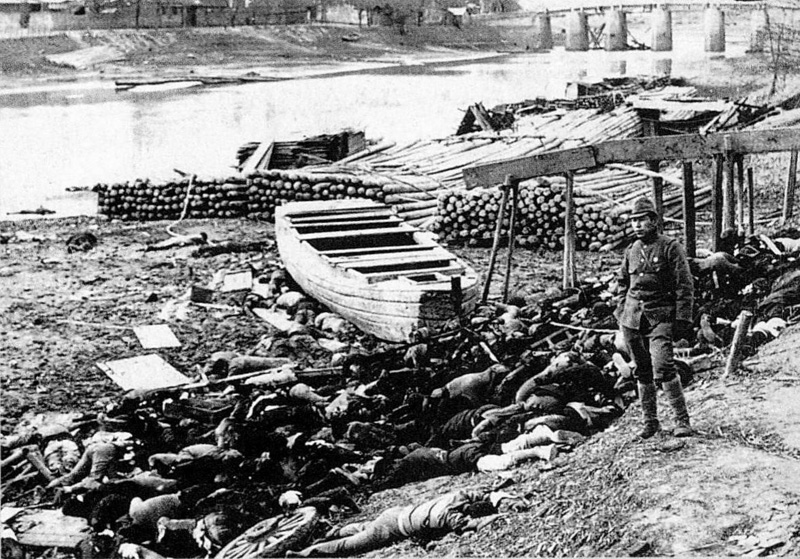
Within a few months, major cities including Beiping (Beijing), Tianjin, Shanghai, and Nanjing fell one after another. On December 13, 1937, the Nationalist capital of Nanjing fell, followed by one of the most horrific atrocities in human history — the Nanking Massacre.
The Nanking Massacre: A Forgotten Holocaust
Based on the International Military Tribunal for the Far East (IMTFE) verdict and the meticulous research of historian Iris Chang in her groundbreaking work The Rape of Nanking: The Forgotten Holocaust of World War II:
- Death toll: 300,000 to 500,000 Chinese civilians and disarmed soldiers were slaughtered by Japanese troops
- Systematic sexual violence: An estimated 20,000 to 80,000 Chinese women were subjected to sexual violence by Japanese troops, many raped repeatedly before being killed
- Arson and plunder: The entire city was looted; historic buildings were reduced to ashes
Japanese forces employed extremely cruel methods including mass beheadings, live burials, burnings, and bayonet impalement. Even Japanese embedded journalists recorded scenes of “corpses lining both sides of the roads, the moat’s water turned red with blood.”
American scholar Iris Chang, with a journalist’s pen, was the first to bring this catastrophe — long neglected by Western mainstream historical narratives — back into international view. Her work has become essential reading for the study of the Nanking Massacre.
Unit 731: Crimes Against Humanity in the Name of Science
In Pingfang, 20 kilometers south of Harbin, the infamous Unit 731 (officially the “Kwantung Army’s Water Purification and Epidemic Prevention Department”), under the command of Lieutenant General Shiro Ishii, was established under the guise of “epidemic research.” The unit conducted unspeakable experiments on thousands of Chinese, Korean, Soviet prisoners of war and innocent civilians:
- Live vivisections: Internal organs removed from conscious, unanesthetized human subjects
- Cultivation of plague bacteria: Plague bacteria were injected into subjects to observe infection and death processes
- Hypothermia experiments: Subjects were tied outdoors and exposed to temperatures of tens of degrees below zero to observe tissue freezing and necrosis
- Poison gas experiments: Chemical weapons were tested on live human subjects
It is estimated that Unit 731’s live experiments killed between 3,000 and 10,000 people. After the war, Ishii and his associates were granted immunity by the United States in exchange for their bacterial research data — an arrangement that remains deeply controversial to this day.
The “Comfort Women” System: Institutionalized Sexual Slavery
The “comfort women” system was another crime against humanity committed by Japanese militarism in Asia. Between 1932 and 1945, an estimated 200,000 to 400,000 women from China, the Korean Peninsula, Southeast Asia, the Netherlands, and other countries and regions were forcibly recruited or deceived into becoming Japanese military “comfort women.”
These women were forced to provide sexual services to Japanese troops and suffered unimaginable physical and psychological torture. Many died from abuse, disease, or suicide. This system was partially denied by the Japanese government for decades after the war. It was only under sustained pressure from victims across Asia and the international community in the 1990s that the Japanese government officially acknowledged this historical fact.
Part 3: The “Greater East Asia Co-Prosperity Sphere”: Ideological Packaging for Imperialism
Origins and Evolution of the Concept
The concept of the “Greater East Asia Co-Prosperity Sphere” (大東亜共栄圏) was first proposed by Japan’s Ministry of Foreign Affairs in 1940, designed to provide ideological legitimacy for Japan’s expansion in Asia. Its core rhetoric was that Japan, as Asia’s only modernized nation, bore the responsibility to “liberate” Asian peoples from Western colonial powers and establish a Japan-led regional order.
This slogan was widely used in wartime propaganda: Japanese soldiers were portrayed as “liberators” rather than aggressors; Japan’s colonial rule was packaged as “shared prosperity.” Yet historical reality formed a stark contrast with this propaganda fiction.
Reality: Oppression and Plunder
The so-called “Co-Prosperity” was in truth oppression and plunder:
- Economic looting: Resources, food, and industrial products from all occupied territories were massively shipped to mainland Japan, with local economies entirely subordinated to Japan’s war needs
- Cultural suppression: Japanese was forcibly promoted as the “national language,” and local languages, cultures, and ethnic traditions were systematically suppressed
- Suppression of resistance: Any form of resistance was brutally crushed; civilian areas were subjected to the “Three Alls Policy” (kill all, burn all, loot all)
The complete failure of the “Greater East Asia Co-Prosperity Sphere” stands as the most powerful testament to the deceptive nature of Japanese militarist ideology.
Part 4: Ideological Roots: How Militarism Was Forged
The Emperor System and Bushido Spirit
The ideological roots of Japanese militarism can be traced to the absolute authority of the Emperor system established after the Meiji Restoration and the extreme reinterpretation of bushido (warrior) spirit. In military propaganda, the Emperor was portrayed as a “living god,” waging war was framed as “loyalty to the Emperor,” and “gyokusai” (death in battle, literally “jewel smashing”) was elevated as the highest honor.
This ideological system completely instrumentalized individual lives, enabling ordinary soldiers to carry out the most cruel orders without moral hesitation.
Anxiety Over “Yellow Race” Competition
After the Meiji Restoration, Japan rapidly completed industrialization, but simultaneously carried a deep anxiety about Western “white race” colonial expansion. Victories in the First Sino-Japanese War (1895) and the Russo-Japanese War (1905) elevated Japan to the status of a great power, yet the opposition to Japan in the “Racial Discrimination Proposal” (1905) at the Imperial Conference intensified Japan’s sense of isolation and expansionist impulses.
The military exploited this anxiety, packaging foreign aggression as an inevitable choice for national survival.
Conclusion
From 1931 to 1945, Japanese militarist aggression brought catastrophic suffering to the peoples of Asia. The 300,000 innocent victims in Nanjing, the mass graves of Unit 731, and the humiliation and suffering of comfort women are scars that can never be erased from human history.
Remembering history is not about perpetuating hatred, but about preventing the repetition of tragedy. Only by confronting history can genuine reconciliation be achieved; only through deep reflection can the specter of militarism be prevented from rising again.
Next in Series: This series’ special supplement will examine the atomic bombings of Hiroshima and Nagasaki — analyzing from a specific historical perspective the arguments for their “necessity” and the ongoing controversies they engender.
References
- Iris Chang, The Rape of Nanking: The Forgotten Holocaust of World War II, Basic Books, 1997.
- Edward J. Drea, Japan’s Imperial Army: Its Rise and Fall, 1853-1945, University Press of Kansas, 2009.
- International Military Tribunal for the Far East (IMTFE) Records and Verdict, 1948.
- John G. H. Duncan, Major Aspects of Japan’s War Guilt, Routledge, 2005.
Leave a comment